
CPSC = Consumer Product Safety Commission
One rule most makers learn early is that cosmetics belong to the FDA. That’s true. In fact, cosmetics are specifically left out of the Consumer Product Safety Act’s definition of a “consumer product.”
You’d think that means that the Consumer Product Safety Commission (CPSC) has nothing to do with your lotions and lip balms, right? Well, not quite.
CPSC can still have some jurisdiction over cosmetics by way of the PACKAGING, not the actual cosmetic formulation itself. You can run into CPSC requirements in three specific places:
- Products made for children,
- Certain formulas that require child-resistant packaging, and
- Packaging that is defective and could hurt someone.
(Soap that isn’t a cosmetic is a different story. Since it is a consumer product, it falls under CPSC to begin with – but all these factors apply to non-cosmetic soap as well as cosmetics.)
1. Children’s Products
A children’s product is one intended primarily for children 12 and under. However, a product for general use doesn’t become a children’s product just because kids use it. For example, a bar soap for the whole family is a general-use product, but soap crayons for kids to play with in the bath are a children’s product.
Kids’ play makeup or manicure kits are children’s products, too. The cosmetics inside (the lip gloss, nail polish or bubble bath) are still regulated by the FDA for safety and labeling. But the rest of the kit and its packaging must meet the CPSC’s safety requirements for children’s products.
Whether your product fits the definition of a children’s product depends on what you say about it, whether people generally recognize it as being for kids, and how it’s packaged, displayed and advertised. Some attorneys have suggested that partnering with social media influencers whose followers include kids under 12 could be seen as marketing to children. CPSC hasn’t taken that position (yet), but it’s worth keeping in mind if your products and marketing lean young or you use influencers who speak to the under-12 crowd.
What’s Required
If you do make a children’s product, these are the main requirements:
- Third-party testing by a CPSC-accepted laboratory, for things like lead and choking hazards.
- A permanent tracking label on both the product and its packaging, showing the manufacturer’s name, the location and date of production, and a batch or run number. For cosmetics, your business name is already on the label. Adding your batch number (which you should be recording anyway) takes care of most of the rest.
- A Children’s Product Certificate (CPC) that you write and issue for each product, stating which safety standards it meets. Give a copy to any retailers or distributors you sell to (you don’t need to provide it to end-use consumers that buy the product).
- Age grading, showing the minimum age the product is intended for, and a choking hazard warning if it contains small parts and is intended for children ages 3 to 6. (Small parts are banned for children under 3, with some exceptions.)
Thankfully, there’s some relief from the testing requirement. If you register with CPSC as a Small Batch Manufacturer, you may be exempt from third-party testing for some products, including most toys and soap. To qualify, your total income from all consumer products in the prior year must be under $1,480,296 (the figure is adjusted annually), and you must make fewer than 7,500 units of the particular product. Registration is free and renewed each year.
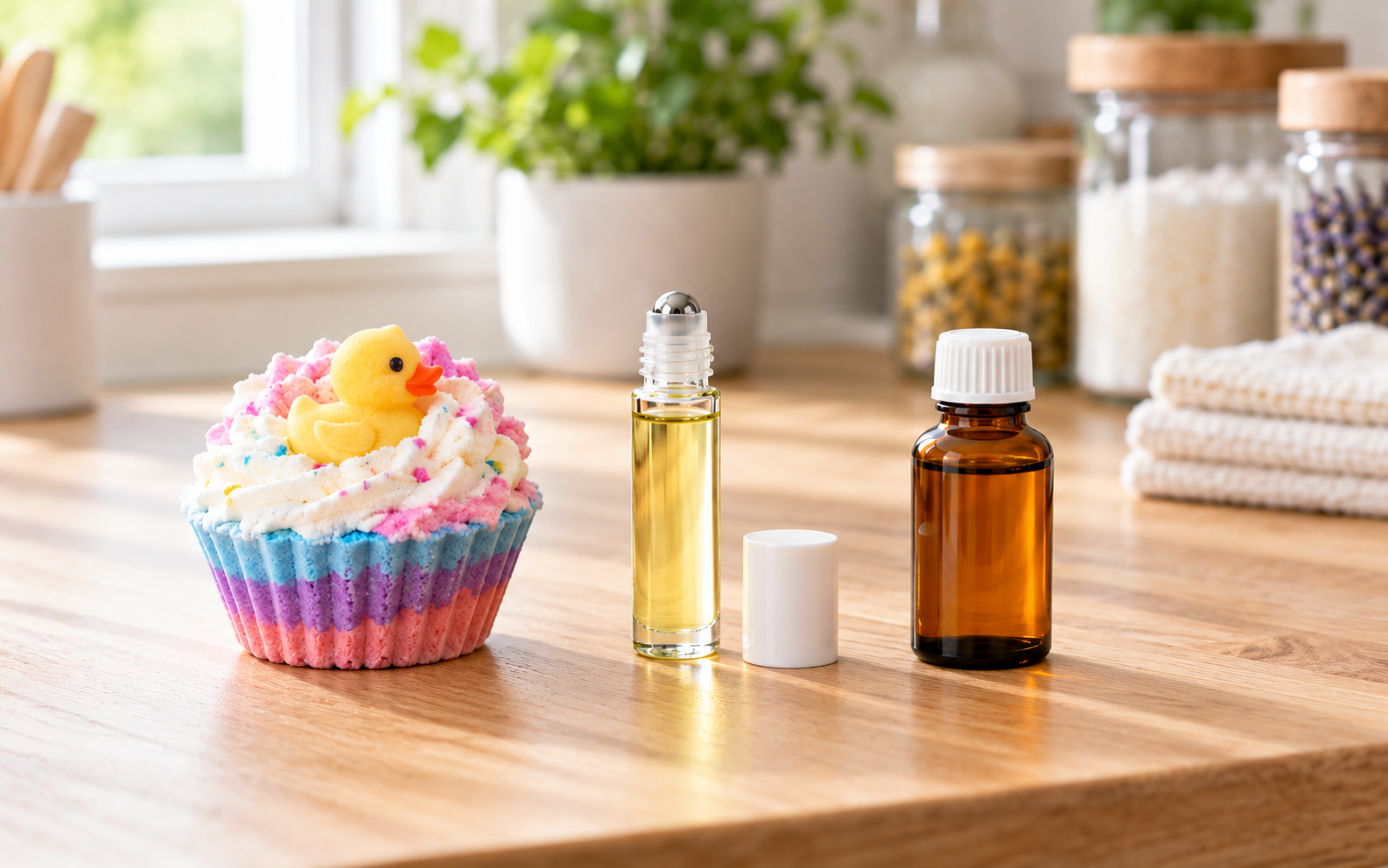
Being exempt from testing doesn’t mean being exempt from safety, though. If you buy toys to include in your products (a little plastic duck embedded in a kids’ soap, for example), get a Children’s Product Certificate from your supplier. If you can’t verify (and have proof on hand) that it meets children’s product safety standards, don’t use it. Be wary of buying toys to embed from retailers (like dollar stores or similar) because you usually can’t get proof that the product meets child safety requirements.
2. Child-Resistant Packaging
Under the Poison Prevention Packaging Act, certain products must be sold in child-resistant packaging. That’s packaging that most children under 5 can’t open (or can’t get a harmful amount out of) in a reasonable time, but that adults can still use normally. For these products, it doesn’t matter if the product is directed at children or not. This is a safety issue so kids can’t get hurt if the product is being used by the adults in their household.
The one that most often affects handmade cosmetic makers is wintergreen oil. Liquid products containing more than 5% methyl salicylate (the main component of wintergreen oil) require child-resistant packaging. As little as a teaspoon of straight wintergreen oil can be fatal to a small child.
There’s also a requirement for certain thin, free-flowing liquid cosmetics (such as some body, bath, massage and baby oils) that contain 10% or more hydrocarbons, a category that includes mineral oil. If you make oils like these with petroleum-based ingredients, check whether your product needs child-resistant packaging.
3. Defective Packaging
The CPSC is responsible for product safety. According to the regulations, a company must report to the CPSC within 24 hours once it knows (or should know) about information that reasonably supports the conclusion that a product has a defect that could create a substantial risk of injury. A product must also be reported if it creates an unreasonable risk of serious injury or death, even if nothing is technically defective.
For cosmetics, there’s already a requirement that you must report a serious adverse event to the FDA. But if it’s the packaging, not the cosmetic itself, that could cause (or has already caused) injury, that needs to be reported to the CPSC. The CPSC has the authority to require a recall.
As an example, in 2022, Vichy Laboratoires sold a facial serum in small glass ampoules. Turns out the glass could weaken over time and break when opened, cutting the user. There were 35 reports of injuries, including one that needed stitches. The report went to the CPSC, and more than 200,000 packages were recalled.
More recently, CPSC announced the recall of about 2.3 million bottles of a rolling liquid candy. The rolling ball could detach and become a choking hazard. That one is a food, not a cosmetic, but if you sell roll-on products, the parallel is easy to see. No injuries had been reported, but the product was recalled because it could become a choking hazard.
Hopefully this will never happen to you, but if you do find an issue and aren’t sure whether something needs to be reported, CPSC allows a reasonable time to look into it, usually no more than 10 working days. Reporting doesn’t automatically mean a recall. But not reporting when you should have can lead to significant civil penalties. There’s no small business exemption.
Final Thoughts
For most makers, CPSC will never come up. But it’s worth asking yourself three quick questions about your products:
- Is anything I make (or the way I market it) clearly aimed at kids?
- Does any liquid product contain wintergreen oil, or a lot of mineral oil?
- Could any of my packaging break, come apart or cut someone, or become a choking hazard for children?
If the answer to all three is no, you’re done. If any answer is yes, now you know where to look.
Knowing where CPSC fits is the first step. The rest is just paying attention to the details.
Leave a Reply