
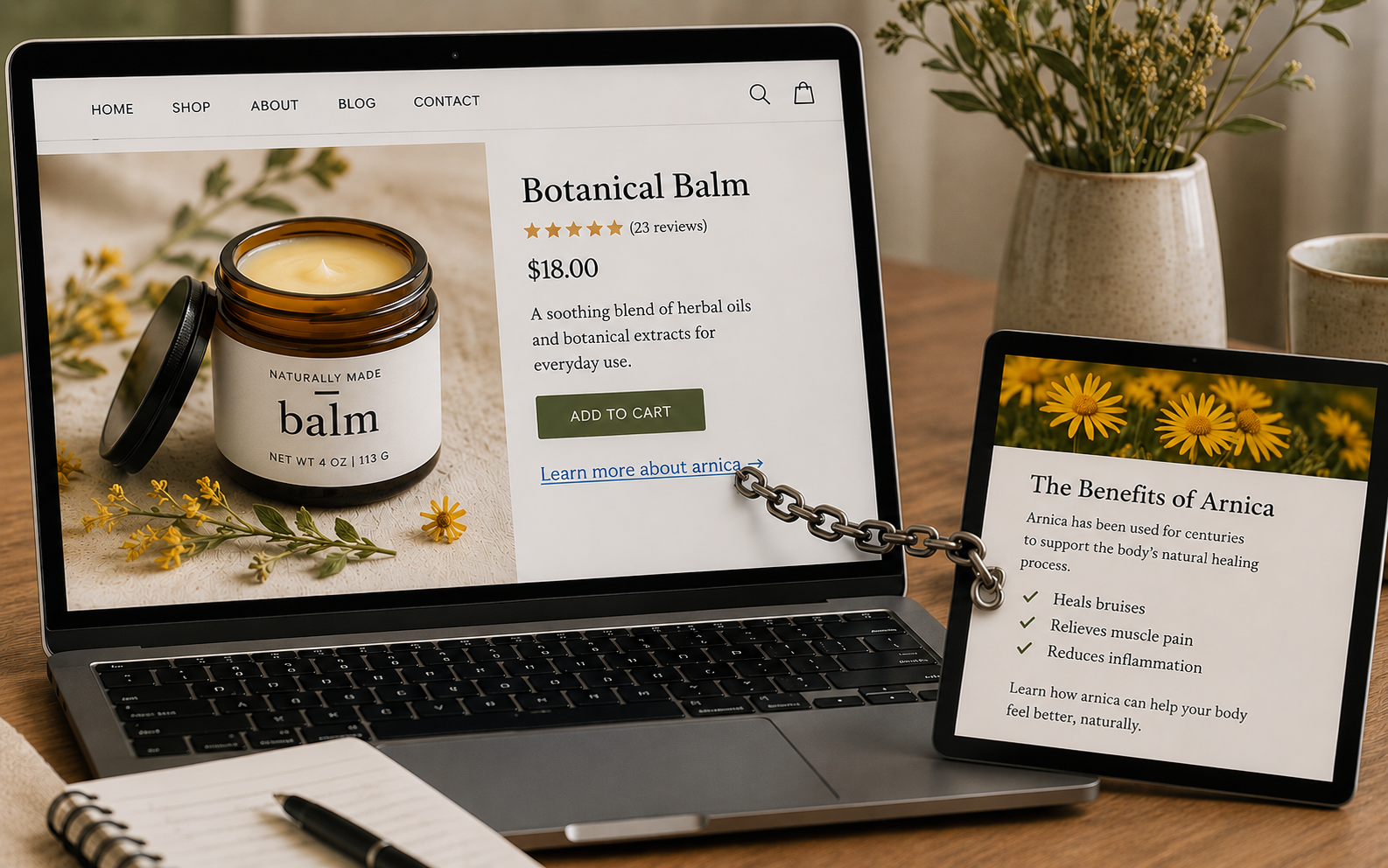
Let’s say make and sell an arnica balm, and you find a really good article about arnica. It explains how arnica has been used for generations for bruises and sore, aching muscles. It’s well written, it’s interesting, and you think your customers would enjoy reading it.
You didn’t write it. You’re not making any of those claims yourself. You’re just adding a link to your website: “Want to learn more about arnica? Read this.”
Seems harmless, right? Nope.
Here’s the part that can be confusing: someone else can legally say things about arnica that you can’t legally say about your arnica salve. Same ingredient, same words, very different legal situation. The difference is who’s saying it, and why.
Two Kinds of Speech
The First Amendment protects speech, but it doesn’t treat all speech the same way.
When a blogger, herbalist, researcher, or nonprofit writes about arnica, they’re generally engaged in what’s called non-commercial speech. They’re sharing information, opinion, tradition, or research, and they aren’t using those statements to sell a particular product (very important!). That gives them a lot of latitude. They might say arnica heals bruises, that menthol relieves sore muscles, or that tea tree oil kills bacteria.
You’re in a different position when you’re talking about the ingredients in a product you’re selling. That’s commercial speech: speech connected to a sale, where you’re using the information as part of selling something. Commercial speech comes with extra restrictions. It has to be truthful, and there are things you simply can’t claim about a cosmetic without changing its legal status.
That’s where this gets important for makers.
When a Claim Becomes a Drug Claim
Under the FDA’s rules, whether a product is a cosmetic or an unapproved new drug isn’t decided just by what’s in it. It’s decided by the intended use, and intended use is determined by what the customer thinks it is for, and that is determined in large part by what you say about the product. That includes your label, your website, your social media, and anywhere else you’re communicating with potential customers.
A cosmetic can cleanse, beautify, moisturize, soften, or otherwise improve attractiveness or alter the appearance. But the moment you say the product treats a condition, relieves a symptom, or alters the function or structure of the body, you’ve moved into drug claims. For example:
- “Arnica heals bruises.” A claim about a condition.
- “Menthol relieves sore muscles.” A claim about a symptom.
- “Tea tree oil kills bacteria.” An antibacterial claim.
- “Our After-Bite cream stops itching.” Changes the function of the body.
Put those on your product page and you’ve potentially made the product an unapproved new drug, something you can’t legally sell as-is. Most makers who’ve paid attention to labeling rules know this part. They keep their own labels and product pages clean.
But here’s the part that’s easy to overlook: what happens if you link to somebody else who makes the claim?
Can the Link Become Your Claim?
Say it about your product and it’s an unapproved new drug. Link to someone who says it, and it may become your claim too.
When you deliberately send your customers to information as part of marketing your product, you may be taking on more responsibility for that information than you realize. The fact that somebody else wrote the words doesn’t necessarily separate you from them, and the fact that the customer has to click a link doesn’t necessarily solve the problem either.
Think about it this way. Your product page says, “Learn about all how arnica has been traditionally used, click here.” You don’t say anything about treating bruises, but the page you send them to says, “Arnica heals bruises and relieves muscle pain.” You’ve done more than share general information about a plant. You’ve deliberately pointed a potential customer to those claims as part of presenting your product. That’s very different from someone finding the same article on their own through a Google search.
This Isn’t Hypothetical
This exact issue reached a federal appeals court this year. In July 2026, the Tenth Circuit Court of Appeals looked at whether a company’s commercial speech could include third-party content the company deliberately directed customers to through links. The answer was essentially yes.
The case wasn’t about soap or cosmetics, but the principle is worth paying attention to. You can’t necessarily avoid responsibility for a claim just by putting it somewhere else and linking to it from your sales material. That’s especially relevant for cosmetics, because the FDA looks at the overall presentation of a product when it decides intended use.
Why It Reaches You
It’s tempting to think this only matters to large companies with lawyers fighting over advertising. But the same basic idea applies to the websites, social media, and marketing that small businesses use every day. A “learn more” link on a product page, a resource page full of outside articles, a recommended-reading list, a social post pointing to an article, a link to a manufacturer’s ingredient information: none of those is automatically a problem–by itself.
The question is what you’re directing your customer to, and how you’re presenting it.
If you’re selling an arnica salve and your site links customers to information saying arnica treats bruises, pain, inflammation, or arthritis, you’ve created a connection between those claims and the product you’re selling. That’s something I’d think about carefully. It is the overall impression the material leaves on a reasonable consumer, that the FDA uses to judge intended use. They look at the marketing as a whole. Regulators aren’t going to read every sentence in isolation and conclude, “Well, technically, that claim was on somebody else’s website.” They’re going to look at what you’re communicating to your customer.
You Can Still Link
Please don’t take any of this to mean you can’t link to anything. There’s nothing wrong with sharing useful information about ingredients. Honestly, it’s one of the best things you can do for your customers. A good article on what an essential oil is, how an ingredient is made, or the history of a particular plant is genuinely useful.
The trick is to look at what you’re linking to before you send your customers there. And don’t just read the first paragraph; read the whole page. What does it say the ingredient does? Does it make disease, treatment, pain-relief, healing, or antibacterial claims? And most importantly: would you be comfortable putting those same words on your own product page? If the answer is no, think twice about sending your customer there from your website.
The Bottom Line
A link isn’t automatically a claim. But it can become part of your marketing message, especially when you’ve deliberately sent a customer to that information in connection with selling your product.
So before you add that “learn more” link, take a few minutes to see what you’re actually asking your customer to read. You don’t have to be afraid of links. Just remember that where you send your customer can be part of what you’re telling your customer. And that’s worth checking before you click “Publish.”
Leave a Reply
You must be logged in to post a comment. Log in or create a free account.