Say “compliance” to most soap and cosmetic makers and — after freaking out a bit — they think of just one thing: the label. That’s understandable because labels get the most attention.
But honestly, your compliance started long before your first label. It started before you even sold your first bar, with a business name, setting up sales tax, and maybe a local permit. Labels are just one piece of a much bigger picture.
Compliance
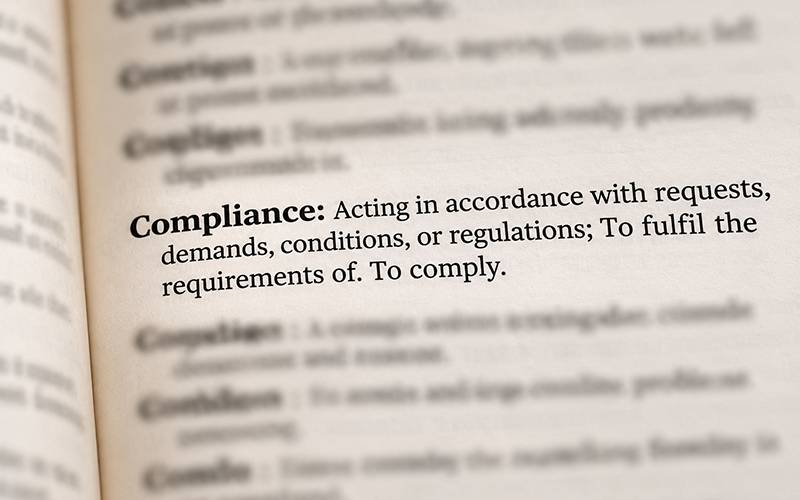
Compliance: Acting in accordance with requests, demands, conditions, or regulations; to fulfill the requirements of. To comply.
In other words, compliance means following the rules that apply to your business. That includes laws, regulations, the contracts you’ve agreed to and even the policies you’ve posted yourself.
It also means being able to show that you follow them. If a state inspector, a customer or your accountant asks, you can pull out the record. If it isn’t written down, it’s very hard to prove.
Non-Compliance
Non-compliance: Failure or refusal to comply with or to act in accordance with requirements.
Non-compliance is not meeting one of those rules. It doesn’t matter whether it was on purpose or by accident, or whether anyone has noticed yet.
Business and Legal Compliance
Taxes are one of the most obvious types of legal and regulatory compliance, but there are others. For example, these are some of the rules every business has to follow, whether you sell soap, candles or cupcakes:
- Registering your business name (a DBA) or your LLC (and filing any required annual reports)
- Getting a sales tax permit, collecting the tax and filing the returns (most states, anyway)
- Reporting your business income and paying self-employment tax
- (Sometimes) A local business license, plus a home occupation or zoning permit if you work from home
- Business bank accounts, credit cards and credit card processing
While none of these are about your products, they are still types of regulatory compliance at the state or federal level. If you’re unsure what your city, county or state requires, your accountant, bookkeeper, or your state’s business page are good places to start.
Soap & Cosmetic Regulatory Compliance
Soap and cosmetic regulatory compliance is like everything else. Some of it is obvious and well-known; other parts aren’t so easy to see and are less well-known (and understood).
Knowing what the rules ARE is the first step. Everything else follows from that.
The Obvious Part – Your Label
This is the part of “regulatory compliance” that most makers already know about. There are specific and detailed laws and regulations that cover what needs to go on your label, where it’s placed, what it needs to say, what size it should be, and what’s not allowed. Every product label needs the product identity, net contents, and the responsible person’s business name and address.
Cosmetics need an ingredient declaration. Some cosmetics need warning statements.
Candles need fire safety warnings.
The Less Obvious Parts – Everything Else
Then there are the rules that exist even though nobody checks them (until it’s too late):
- MoCRA. Even if your business is small enough to be exempt from facility registration and product listing, there are still parts of MoCRA that apply to all cosmetic makers. You need safety substantiation for your products and you must report serious adverse events.
- Your claims. What you say on your website and social media about your product determines if it is a cosmetic or not. The laws and regulations prohibit the sale of “unapproved new drugs” – and if you make claims that your product will treat or heal anything, it becomes an illegal unapproved new drug.
- Color additives. Only approved colors can be used in cosmetics, and some are restricted to certain uses. (This doesn’t apply to soap that is not a cosmetic.)
- State rules. Florida requires a cosmetic manufacturer permit (with a small business exemption), and California has its own ingredient reporting requirements. Several other states have rules or laws that apply to cosmetics and/or all products.
- Packaging. In some situations, product safety rules apply to cosmetic packaging.
- Children’s products. Any products intended to be sold to or used by children (age 12 and under) have specific requirements, including testing (there are some exemptions) and sometimes warning labels.
- Environmental claims. Statements that a product is “eco-friendly” or “green,” or even ecycle symbol, are now subject to a whole raft of regulations designed to put a stop to “greenwashing.”
Contracts You’ve Agreed To
You’ve probably agreed to more rules than you realize. Etsy, Amazon and Shopify all have seller policies. Wholesale accounts have terms. Show and market vendor contracts often require liability insurance and a sales tax permit. Breaking those terms is non-compliance too, even if no government agency is involved.
Your Own Rules
This one surprises people. Anything you post becomes something you have to live up to: your return policy, your privacy policy and statements like “every batch tested.” If you say it, you need to do it.
Not All Non-Compliance Is Equal
A missing net contents statement isn’t the same as making drug claims. Roughly speaking:
- Serious: adulterated or unsafe products, drug claims, ignoring a serious adverse event, operating without a required permit, failing to pay taxes
- Significant: missing or incorrect label elements, not collecting sales tax, not registering your business name, false or misleading advertising
- Minor (but it adds up): records that aren’t up to date, a policy you no longer follow
The minor ones are easy to fix. They just tend to become significant ones if they’re left alone.
How It Usually Happens
Usually it isn’t carelessness. It’s one of these:
- You didn’t know the rule existed.
- The rule changed (MoCRA is a good example).
- Your business grew past an exemption.
- You copied a label from someone else, and theirs was wrong.
- Your supplier changed an ingredient, and your label didn’t change with it.
Keeping It Simple
You don’t need a compliance department. A few habits go a long way:
- Make sure you know what you are supposed to do and what rules apply (Compliance Advisor can help there).
- Work out a good filing system for your permits, licenses, reports, tax returns, and other important papers.
- Put filing and renewal dates on a calendar: sales tax returns, annual reports, permit renewals.
- Check your labels and website any time something changes, whether that’s a new product, a new ingredient or a new rule. (Compliance Advisor can help here, too.)
Final Thoughts
Compliance sounds big and official, but for a small soap or cosmetic business it really comes down to knowing which rules apply to you and keeping a record that you follow them.
Once you know what’s on the list, it stops being a mystery. It’s just part of running a real business, and you’re already doing a lot of it.
Leave a Reply