
When most makers think about getting in trouble for a label problem, they picture the FDA. Maybe the FTC. A government letter. An inspection. And yes, that can happen.
But there’s another path to trouble that doesn’t get talked about nearly enough: civil lawsuits filed under state consumer protection laws. And it probably happens much more often.
A Recent Lawsuit
A class action lawsuit was filed in California in March 2026 against Pacha Soap Co. for their Hand in Hand brand, specifically the hand soap, body lotion, body wash, and sugar scrub, marketed under their “Sea Salt / Sweet Mint & Eucalyptus” fragrance line. Those three ingredients are prominently featured on the front labels. According to the lawsuit, the actual ingredient lists don’t contain any of them.
The “Sea Salt / Sweet Mint & Eucalyptus” scent is identified in the ingredient declaration as “fragrance,” which is completely legal and commonly done. The problem isn’t the fragrance. The problem is that the front label, the website copy, and the marketing all represented sea salt, eucalyptus, and mint as actual ingredients in the product, when they were apparently only components of the fragrance blend — if they were present at all.
Label Text, Ingredient Declaration and Website
Here’s what makes this case so worth paying attention to.
The front labels on all the Hand in Hand Sea Salt products prominently displayed “Sea Salt / Sweet Mint & Eucalyptus.” They are positioned and styled to look like key functional ingredients in the product, not just the scent of it.
The ingredient list tells a different story. The scent is listed as “Fragrance.” That is completely legal. Listing a fragrance blend as “Fragrance” is standard practice and fully compliant with cosmetic labeling requirements. There is nothing wrong with it.
Then there’s the website. The Sea Salt Body Lotion is described as having “an energizing and crisp blend of eucalyptus and sweet mint.” The Sugar Scrub said it was “infused with rosemary oil and mentha arvenis leaf oil adding a sweet mint aroma.” Those descriptions actually clarified that the eucalyptus, mint, and other botanicals were components of the fragrance. Again, totally legal. For customers who bought online, that context was part of the labeling they saw. (Note that sea salt is not mentioned, and eucalyptus isn’t mentioned in the Sugar Scrub description.)
But for customers who bought the product in a store, none of that context existed. They saw the front label featuring sea salt, eucalyptus, and mint. They saw “Fragrance” in the ingredient list. There was nothing on the package to connect the two; nothing to indicate that those prominently featured names were actual ingredients in the fragrance formulation. That’s the discrepancy the lawsuit is built on.
When your front label features an ingredient, your website describes it as a key component, and your ingredient list says “Fragrance,” you’ve created an inconsistency. It may not be intentional (and it may be completely legal), but it can still be used against you.
Enforcement Doesn’t Always Come From the Government
This case was filed in federal court in California. Like most states, it has consumer protection statutes that allow consumers, via their attorneys, to sue businesses for deceptive practices, false claims, and misleading labeling. In plain English, that means the consumer is claiming she was somehow tricked into buying the product and wouldn’t have spent the money if she’d known the “truth.”
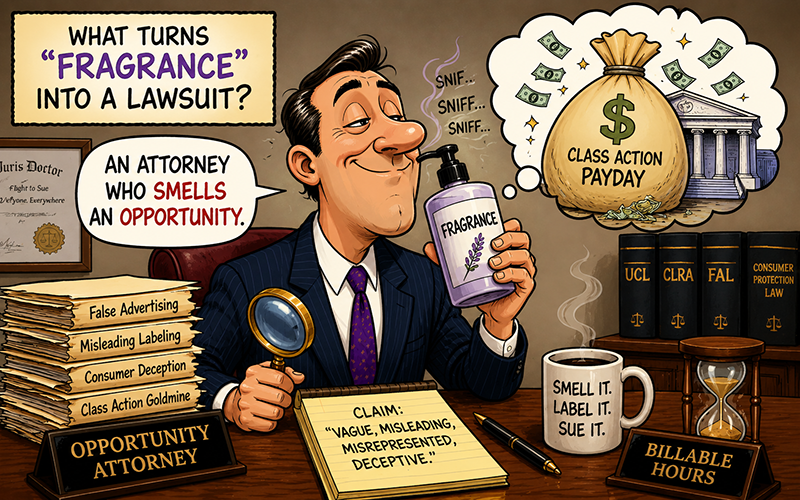
I’ll be honest with you: most of these cases aren’t filed because a consumer was genuinely wronged and went searching for justice. They’re filed by attorneys who have made this their business model. They are like the ambulance-chasers for product lawsuits. They scan product labels and websites looking for gaps and inconsistencies, recruit a plaintiff, and file a lawsuit. Then they work to convert it into a class action case where that one person’s claim suddenly purports to represent every single person who ever bought the product. That’s where the numbers get very large very fast. For example, this lawsuit claims damages well in excess of $5,000,000. (And, of course, the attorney gets a substantial cut of that if they win.)
California, Illinois and New York are the easiest places to file this type of lawsuit because of their laws. In fact, in those states there are whole enclaves of attorneys who just do these cases. The product doesn’t have to be made there; it’s based on where the consumer is located and purchases the product.
It is important to realize that underlying claims may or may not have real merit; that’s for the court to decide. What I want you to understand is that the financial and emotional cost of defending even a questionable lawsuit is real. These cases don’t have to succeed (or even be fair or right) to cost you dearly in terms of legal fees, sleepless nights, and emotional distress.
Final Thoughts
Two things I’d encourage you to do after reading this.
First, take a look at your full labeling — not just your label, but everything that goes with the products one way or another. Read your product pages, your social media posts, anywhere you’ve described what’s in your products. Make sure everything is consistent and truthful.
Second, if you don’t have product liability insurance, seriously consider getting it. General liability coverage is not the same thing. Product liability insurance covers claims arising specifically from your products, including labeling-related lawsuits like this one. The cost of a policy is a small fraction of the cost of defending a class action — even one you ultimately win.
Your label is a legal document — it’s your promise to the customer about your product. The good news is that getting it right isn’t that complicated — it just takes care and consistency.
Leave a Reply