
Estimated reading time: 5 minutes
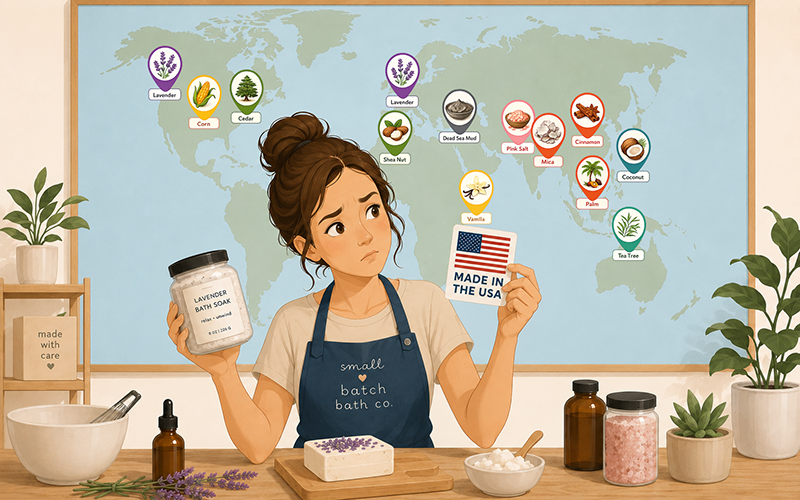
When soap and cosmetic makers think about “Made in USA,” they think about where they make the product. Their studio. Their kitchen. Their production space, right here in the United States. Yes – you are in the United States … but that’s not the whole picture.
Since “Made in the USA” is an important – and often abused – marketing claim, there are laws and regulations that cover exactly when you can (and can’t) say that. And it’s not only the words “Made in USA” that count. “Handcrafted in Tennessee.” “Created in America.” “Proudly American Made.” American Flag. Anything that gives consumers the impression of American origin fall under those regulations. It can even be a Made in “My State” Claim.
“Made in USA” Is a Real Legal Thing
To say something is “Made in the USA” when it’s not (meaning that it doesn’t meet the requirements in the laws and regs) is an unfair or deceptive trade practice. Bottom line? It’s illegal and, in the worst-case scenario, could be subject to civil penalties.
What’s Actually Required
Any flat-out “Made in USA” claim requires the product to be “all or virtually all” made in the United States — meaning:
- Final assembly happens here,
- All significant processing happens here,
- All key ingredients are made and sourced here.
- All or virtually all ingredients are made and sourced here.
All four. Not just one or two. All.
Key ingredients are the ingredients that are important to the manufacture or marketing of your products. If you highlight “extra virgin olive oil,” or “Lavender oil from France,” or “Shea Butter” those become key ingredients. If it’s “Tea Tree Soap,” then the tea tree oil is a key ingredient.
All or virtually all means exactly that. It’s based on both the percentage of the ingredient in the formulation AND the percentage of the cost of that ingredient in the total cost to make the product.
Now apply that to a soap or cosmetic formula.
Last I checked, we don’t have coconut or palm plantations in the United States. Coconut oil comes from Southeast Asia. Palm oil from Malaysia and Indonesia. Shea butter from West Africa. Lavender from the famous fields of Provence, France. Vanilla from Madagascar. Cinnamon from Sri Lanka. Mica — the stuff that makes everything sparkle — largely from India.
If your ingredients are coming from all over the world, a straight “Made in USA” claim doesn’t hold up.
Enforcement – Laws and Lawsuits
In March 2026, a Presidential Executive Order directed the FTC to make “Made in USA” enforcement a priority. They were already moving strongly in that direction. Starting in mid-2025, the FTC had been sending warning letters to companies with questionable claims. Companies that didn’t act ended up in federal court. In April 2026, three cases settled:
- TouchTunes (dartboards assembled here, key components imported) — $625,000
- Americana Liberty (“100% American Made Tough” flags made in China) — $167,743
- Oak Street Bootmakers (“handcrafted 100% in the U.S.” footwear, components from Dominican Republic and Brazil) — $75,000
Granted, these recent cases were about parts, not ingredients. But an earlier case (2021) makes it pretty clear. It was against Chemence, a superglue manufacturer. They manufactured here, but foreign materials made up more than 80% of the material cost and more than 50% of the overall manufacturing cost. Fail! Just making the product here wasn’t enough. The settlement was for over $1.2 million.
California, our friendly highly-regulated state, has its own stricter “Made in the USA” standard, which caps foreign ingredient content at just 5% of total wholesale value.
But a state doesn’t need a specific “Made in the USA” law for lawsuits to be filed. “Made in USA” claims are yet another area where plaintiff attorneys have carved out a specialty niche. (See When Your Label Gets You Sued)
- Bigelow Tea was sued because they claimed “Made in the USA” when the tea was packaged in the US, but the tea leaves came from India, China, and Sri Lanka. It was settled last year – a jury awarded the plaintiffs $2.36 million. (California)
- Bigelow Tea was also sued in another case for the same thing – manufacturing in the US but tea from other countries. It’s still pending. (New York)
- In 2025, John Paul Mitchell Systems was sued over its “Tea Tree” line of shampoos and conditioners, alleging that they claimed “Made in the USA,” but the key ingredients (tea tree and others) weren’t from the US at all. (Illinois)
- Currently, a law firm with offices in California and Washington, D.C., is actively investigating an Ohio-based pet food company to get information for a potential “Made in the USA” lawsuit concerning foreign sourcing of its ingredients.
The pattern is always the same: product processed domestically, key ingredients sourced internationally, unqualified claim on the label.
Unforturnately, that describes a lot of soap and cosmetic products.
What You CAN Say
A qualified claim lets you honestly describe what’s true. The FTC gives examples like:
- “Made in USA with U.S. and imported ingredients” (see Made in the USA – A Good Example)
- “Blended and bottled in the USA”
- “Handcrafted in our [state] studio using globally sourced ingredients”
If you’re genuinely crafting here, you can say so — just say so accurately.
Final Thoughts
Know what you are working with so you know exactly what you can say.
Go through your formula and document where each ingredient actually comes from. That’s not the supplier that is located in the US, it’s the place where the ingredients were made or grown.
Then check your full marketing footprint — your label, your website, your social media, your shop listings — for anything that implies full-on American origin.
Honestly? The FTC is focused on larger companies. But the rules are the same for everyone, and the risk doesn’t disappear because you’re small. Better to be accurate now than to be scrambling later. And then there are those darn attorneys….
“Made in USA” means something real to consumers. It’s good marketing. Definitely use it — if you can back it up.
Leave a Reply